Showing posts with label Science Fiction and Fantasy. Show all posts

Thursday, February 6, 2014

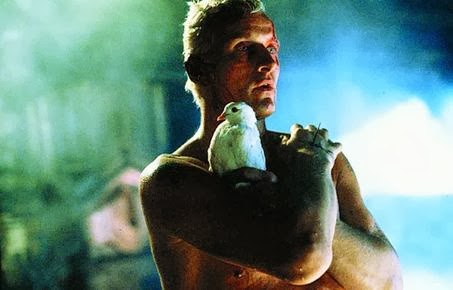
Blade Runner (1982)


 "Blade Runner" is how a science fiction film SHOULD be made, as a speculative thinker, not as a silly disposable piece of throwaway camp like "Star Wars" (yes, I dissed George Lucas' Magnum Opus. I can see you fanboys writing that down.) I won't place this on the pillar of perfect science fiction like "Firefly" ('cause I just won't,) but the creativity of the whole enterprise shines through, past the dark sets and blackened hearts of the characters.

   Early in the 21st Century (yep, folks, we should be seeing some crazy shit real soon,) Tyrell Industries has refined the android model to the brink of perfection. These beings, called 'replicants,'  are man-made entities virtually identical to the human but used for all the dirty work- war, prostitution, dangerous jobs. They were implanted with memories that are not their own and manufactured to feel no empathy or identity as an individual.

   But things have changed. Replicants have formed a consciousness of their own and have become too dangerous to keep. That's where Deckard (Harrison Ford) comes in. Deckard, a 'Blade Runner,' is assigned to kill illegal Replicants. In turn, a group of Replicants attempt to force their their creator, Dr. Tyrell (Joe Turkel,) to increase their longevity (the androids have a maximum life span of three or four years.)


   It's Deckard against Roy Batty (Rutger Hauer,) the maniacal, intelligent leader of the Replicants, and his three cohorts. And you know what? I kind of wanted Roy Batty to win. He's a great, complex character, even though he goes to violent extremes to get what he wants (I felt for two of the victims, but less for the third.) Deckard is frankly kind of a bore. He's typical stoic Ford, and the way he borderline-rapes beautiful female Replicant and love interest Rachael (Sean Young) is a little sickening.

   I liked Batty a lot, but I was equally taken with J.F. Sebastion (William Sanderson,) and eccentric and somewhat childlike inventor suffering from Methuselah Syndrome, which leaves him prematurely aged.  He's a little talked about character, but I find him just as interesting as Batty. J.F. picks up waifishly appealing Replicant Priss (Daryl Hannah) and takes her home with him, a decision that turns out to be the worst of his life.

 
 There are a few corny scenes and lines (like "Wake up! Time to die!", uttered by Leon (Brion James,)) but the movie is very original and iconic. I love the unique sci-fi vision originally created by Philip K. Dick (author of the book 'Do Androids Dream Of Electric Sheep?' that "Blade Runner" is based on) but brought to life by Ridley Scott. The movie's world is damp, dreary, but strangely compelling. The final confrontation is sad and creepy and maybe even a little darkly humorous, all at once.

 Rutger Hauer's performance as the lead android is wonderful. He is creepy yet tragic, all he wants is more time. In a world where humans have really screwed their creations over, the creations want to feel the sunlight a little longer, to live to see the world through aged eyes. Why should their experiences mean any less? The final line by Hauer (..."Like tears in the rain") perfectly summarizes this.

   "Blade Runner" is a classic movie that is most definitely worth multiple rewatches. It's important in that it deal with the moral quandaries of science and creation, the way 'Frankenstein' did. It features a stunner of a performance by Rutger Hauer (too bad he plays in so much crap now...) and a chilling orchestral score. Watch it. Watch it more than once, if you haven't already, and think about the implications behind it and films of it's ilk.
                                            Rating-
                                                   8.5/10


Sunday, October 6, 2013

Tideland (2005)

"Tideland," Terry Gilliam's fantastical horror brain child, is an undeniably original, unmistakably repulsive journey into the life and mind of one troubled little girl (Jodelle Ferland.) To say it outstays it's welcome it an understatement, the film clocks at over two hours and leaves an undeniably bad taste in one's throat. The characters are hard to comprehend, much less like or understand.

   All this would be bad enough without the bizarre intro by Terry Gilliam, who vaguely informs us that children 'bounce back' from situations such as these and tells us 'don't forget to laugh.' But what is there to laugh at in a disgusting horror show such as this?  it's as if Dave Peltzer of 'A Child Called It' fame had promised us a knee-slapping good time.

Monday, September 30, 2013

Once Upon A Time Review- Pilot

    Enchanted forests. Evil step-mothers. Strange, wondrous creatures. At a certain age, isn't it time to put away such childhood fantasies? Damaged but beautiful bail bondswoman Emma Swan (Jennifer Morrison) thinks so. Tough yet troubled, she has no time for fairy tales. But when a child from her past (Jared Gilmore) finds her and takes her to Storybrooke, a town harboring fairy tale characters lost in time, Emma must consider that the unimaginable may be, in fact, closely linked to her life.

   Not that is seems that way at first. The inhabitants of Storybrooke don't know they're fairy tale characters. They are living a puzzling, but rather sedate, lives, victims of a curse that has robbed them of their wonderousness. The pilot of this show follows the fairy tale beings as they fight the evil curse, and Emma, who occupies the present, continuously skeptical of the magical events surrounding her.

Sunday, September 1, 2013

Paperhouse (1988)

When I was a little girl, my younger brother and I were convinced if we strapped enough household wires to each other and fell asleep in the same bed, we could meet each other in our dreams. Of course, my mom told us it was impossible, but that didn't stop us from trying. Children with my wild imagination and faith in the impossible would love the concept of "Paperhouse."

   Of course, "Paperhouse" has a very adult angle that makes it, ultimately, best for grown-ups. 11-year-old Anna (Charlotte Burke,) who is at that age where kids mouth off to their elders and will pick a fight over absolutely anything, faints in school on her birthday and is discovered to have a raging fever.

   Bizarrely, when Anna faints, she discovers that when she's unconscious or asleep, she enters a world entirely unlike her own- to be precise, to a remote house she has drawn before her dizzy spells began. In the house she meets a boy, physically handicapped Marc (Elliot Speirs, who died at a tragically young age,) who bears startling similarities to a boy with muscular dystrophy who Anna's doctor (Gemma Jones) is seeing, and who Anna has never met outside to dream world.

Saturday, August 31, 2013

The Blackwater Gospel (2011)

Although this is a pretty obvious short on the evils of religion, the animation here is breathtaking, the visuals frightening, and the script, for the most part, is pretty damn good too.

   The angel of death, 'the undertaker,' is picking off the frightened residents of a small town, while the town's evil priest leads them on a witch hunt, leading to one man- the faithless, guitar-plucking hobo, who refuses to comply with the priest's reign of terror.

   The corpse-like characters are truly grotesque and frightening, scarier than anything Burton could come up with. The bloody conclusion isn't stylized or humorous either- it's unflinching brutality is unnerving. There's also some pitch-black humor concerning religious hypocrisy, but it does little to relieve the unrelenting tone.


Thursday, August 22, 2013

The Thirteenth Floor (1999)

"The Thirteenth Floor" starts out with a great concept and proceeds to flay it with the efficient brutality of a certain gender-flexible character in "The Silence of the Lambs." If you've seen "The Silence of the Lambs," you'll know who I'm talking about (hint- his initials are BB.) If you haven't, never mind it, but realize that plot of "The Thirteenth Floor" isn't nearly as good as it sounded on paper.

   Brilliant computer expert Hannon Fuller (Armin Mueller-Stahl) has created a world beyond his wildest daydreams. Using cutting-edge virtual reality techniques, he has created the his childhood home- 1930's Los Angeles, populated by conscious, thinking, reasoning people, who are nonetheless only characters in a virtual world.


Tuesday, July 30, 2013

They Live (1988)

they liveThey Live (1988)

Directed By: John Carpenter

Written By: John Carpenter, Based On a Short Story Titled "Eight O'Clock in the Morning" by Ray Nelson

Verdict: Two Thumbs Down from James and Me


Sunday, July 21, 2013

Wizards (1977)

   Ralph Bakshi's innovative post-apocalyptic vision of ruin and technological warfare is not for the kiddies, despite the PG rating. Instead, it offers creative hand drawn animation and food for thought for adults and teenagers who might find it's content a springboard for discussion.

   Thousands of years after nuclear war, most of mankind has transformed into disgusting dribbling mutants. Meanwhile, the ancestors of the earth have come to stay- fairies, dwarves, elves, and the like. One night, a fairy woman gives birth to twins; one, Avatar standing for all that is gentle and good, the other, Blackwolf, representing evil and corruption.

   After growing up and defeating Blackwolf (voiced by Steve Gravers) once in battle, Avatar (voiced by Bob Holt) retreats to live a life of access with his female companion Elinore (voiced by Jesse Welles.) Meanwhile, the evil Blackwolf lingers underground  and plans his revenge, using Nazi Germany and Hitler as his inspiration for a reign of terror.

Monday, April 22, 2013

The Princess Bride (1987)

"The Princess Bride" is that rare classic that can be enjoyed by all members of the family, regardless of age. It is also a cute, mostly clean comedy that won't bore adults or go over the heads of kids.

   In plotline #1, A sick little boy (played by 80's child-star Fred Savage) is presented by his grandfather (Peter O'Toole) with- not an Atari video game, as he no doubt would've hoped- but a leather bound book, 'The Princess Bride.'

   We are soon pulled into the book and it happenings- of its characters, and lively scenes of swashbuckling and daring-do. Princess Buttercup (Robin Wright Penn) loves Wesley (Carey Elwes,) a lowly stable boy, so naturally she torments him and heckles him with constant petty demands (I've never understood why these kind of women always get hitched first- ideas?)

    Wesley has neither the lineage nor the money to wed Buttercup, so he seeks his fortune at sea, where he meets an uncertain fate at the hands of the Dread Pirate Roberts. Swearing never to love again, the beautiful Buttercup is nevertheless pursued by the douchey Prince Humperdinck, but her kidnapping at the hands of a trio of oddballs only complicates things for the princess.

   The script here is a lot of fun, and the actors' near-perfect delivery of their lines results in one of the most quotable films in movie history. The acting is strong even from the minor players, including Christopher Guest as the devious Count Tyrone Dugan and Mel Smith as the expressive and quite sadistic albino.

   One complaint is Buttercup herself, who takes the cake as the most insipid movie princess of all time, and that includes the sappy, crappy, fragile princesses of early Disney. When she isn't planning her own suicide and badgering Wesley, Buttercup can usually be found crying tears that don't seem to dampen her crystal-clear complexion.

   Despite my animosity towards the fragile, soppy heroine, I concede that "The Princess Bride" is a both a perennial classic  and a movie worth cherishing and sharing with the younger generations, who may nonetheless be skeptical of the 80s' effects. Fun and excellently written, "The Princess Bride" is worth past-tripping for.


Wednesday, March 27, 2013

Rise of the Planet of the Apes (2011)

Okay, confession time- this is my first "Planet of the Apes" movie. I have never seen the Charlton Heston original. Hell, I haven't even seen the crappily reviewed Tim Burton film with Helena Bonham Carter and Mark Wahlberg.

But I have to say, despite my lack of experience with the "Apes" franchise, this one grabbed my attention right away. This is up there with Neill Blomkamp's "District 9" as science fiction at its most emotionally charged, tinged with social commentary.

This is a star-studded cast -- James Franco, John Lithgow, Tom Felton of the "Harry Potter" films -- and yet the film belongs to the apes. These CGI wonders are incredibly realistic, and through the magic of modern technology, given the facial expressions of actors.

Thursday, March 14, 2013

District 9 (2009)

I wasn't a fan of this film when it first came out, but I must admit after three or four viewings I have quite grown to like it. It's an action movie, and for all intents and purposes an intelligent one, but don't expect a ton of depth in terms of character development or symbolism.

   The plot is pretty simple- a colony of about 1.5 million bug-like aliens have their ship break down on them above Johannesburg. After several months of the ship just, well, hovering there, a team of people get inside the ship and find that the aliens are agitated, starving, and living in their own filth.

   The "colonization" of the aliens goes pretty much exactly the way I thought it would in reality -- no laser beams, no probing, just good ol'-fashioned oppression and humans sticking their noses where they don't belong. The people build a ghetto for the aliens to live in squalor and fear, and tensions rise.

Thursday, February 14, 2013

Book Review: 11/22/63 by Stephen King


Trish put me up to buying this book in Kindle format when it went on sale for $3.99. I've gotta say she scared me a bit when she said the book was getting too intense and she might need to put it in the freezer. :-) But it ended up being a great read.


Monday, October 15, 2012

Book Review: Genus by Jonathan Trigell -- Dark Dystopian Fiction, Anyone?

Publication Date: 2011

Publisher: Corsair, Constable & Robinson, Ltd.

Format: Paperback

Genre:  Literary Fiction/Dystopian

Why I Chose It: Because it was written by the author of Boy A, which I loved; many thanks to the author and publisher who kindly gave me a copy of this novel with no obligation to publish a review.

Rating: (5/5 stars)

Thursday, February 2, 2012

Eifelheim by Michael Flynn


Eifelheim opens in August, 1348 in the German village of Oberhochwald. As Dietrich, the parish priest, begins his daily rituals, the area is struck by a freak storm, and an electrical charge sparks a great fire. Believing this marks God's final judgment, parishioners offer their confessions -- disclosing sins that are already common knowledge in the small village.

In time, they realize an alien race, landed "from the stars," has crashed in a nearby forest. The villagers struggle to fit this into their understanding of reality, which is based on an earth-centered universe -- the visitors are first believed to be lepers or demons. On the other hand, the locals are predisposed to accept the existence of unusual creatures by their rich tradition of folklore. Their church is decorated with remnants of Greek mythology, like centaurs, and creatures with deep roots in German "pagan" tradition, including giants, elves, and kobolds. The church carvings also include wyverns, gargoyles, and basilisks. All these creatures blend seamlessly with images of their patron saint and the last supper.

Eventually the villagers become accustomed to the presence of the aliens, who use a device to communicate with the earthlings. Their intellect is equal -- or superior -- to humans, and they bring ideas that strike the reader as modern. For example, their language is woven from what appears to be binary code, and they recognize that tiny organisms cause disease. On the other hand, their sensibilities are very different. They are guided by instinct rather than empathy, and they have difficulty understanding the concept of charity or grasping the nuances of human language. Dietrich ponders whether the visitors have souls, sparking thought provoking questions about what it means to be "human."

Meanwhile, battles loom, and Oberhochwald faces the judgment of other villagers and of powerful people in the church, who suspect them of harboring demons. The Black Plague, which is decimating the population throughout Europe, is closing in. These elements form a story that's compelling and tragic.

In a parallel story, modern scholars Sharon and Tom grapple with challenging academic questions. Sharon, a physicist, is pondering the nature of time and space, closing in on an explanation of how someone might cross galaxies. Her lover Tom is a cliologist, engaged in a mathematical study of history. He is baffled by the disappearance of a medieval German village that vanished during the Black Plague and was never resettled.

Sharon and Tom's relationship and academic quests are intriguing, but these characters are one dimensional. They seem to exist primarily as a plot device and as a way to dabble in a blend of real and fanciful quantum physics. The primary story -- the tale of Oberhochwald -- is much deeper and richer.

Dietrich, the parish priest, is at the heart of the story. He is a thoughtful man, well versed in science and logic; he had received a rich classical education and studied medicine, with some of the great minds of the time, in Paris. He is also a passionately dedicated, compassionate priest who hides dark secrets of his own. The village is vividly recreated, revealing the author's many layers of knowledge about medieval manoral life and the science, philosophy, theology, and worldview of the European Middle Ages.

I was fascinated by this vibrant, thoughtful portrait of medieval Germany and by the interaction between their people and an alien species. The writing is beautiful -- this author is really a master of his craft. And I enjoyed the vivid descriptive writing, which brought Oberhochwald to life, and the clever humor.

Here is a snippet:
They crossed over the millbrook bridge and took the road toward Bear Valley. The fallow fields lay on the left and the autumn fields on the right, the ground swelling higher and edging into the dirt track, pinching it until it seemed more trench than road. Hedgerows and briar bushes, meant to keep cows and sheep from wandering into the croplands, provided a bit of inadvertent shade to the walkers -- and seemed veritable trees by reason of the height of the land from which they sprouted. The road, muddy through this stretch from a rivulet tributary to the millbrook, meandered first this way, then that, as slope and pitch dictated. Dietrich had wondered at times what sort of place Bear Valley might be that travelers seemed disinclined to go straight there.
And here's a bit that made me smile:
Items had been appearing regularly in his Eifelheim file, all properly beribboned and pedigreed like dogs at a kennel show. Judy was a meticulous researcher. She had located monastic annals, uncovered manorial accounts, unearthed tantalizing odds and ends -- the haphazardly preserved detritus of a vanished world ... (a list of documents follows) ... A levy dated 1289, in the Generallandesarchiv Baden, by Markgraf Hermann VII of Baden on Ugo Heyso of Oberhochwald for six-and-a-half foot soldiers and one-and-a-half horse soldiers ...Why, the question of how a vassal might supply six-and-a-half soldiers to his liege is one to occupy a salon of Jesuits.
I found Eifelheim a challenging and very slow read. In a way, I appreciated the slow pace, as there was a wealth of interesting ideas to absorb. On the other hand, I sometimes found it tedious and had to prod myself to keep going. There were too many characters to get to know well, and the slow, methodical pondering of medieval philosophy weighed down the flow of the storytelling.

This novel shines with a wealth of fascinating knowledge and intriguing ideas, exploring quantum physics, human thought through the ages, good vs. evil, and variations on being "human." But the storytelling, which should have been the heart of the book, often seemed to be held captive by the author's desire to pack in so many ideas. It's a book that many readers will find brilliant and others will find tedious; some -- like me -- will experience a bit of both. Nevertheless, this is a story I am unlikely to forget.

Read More Reviews: Claw of the Conciliator; A Good Stopping Point


Rating: 4


5- Cherished Favorite4 - Keep in My Library3 - Good Read2 - Meh1 - Definitely Not
For Me

Thursday, January 12, 2012

Dogsbody by Diana Wynne Jones


Sirius, who inhabits the "dog star," has been tried and convicted of a terrible crime. He banished to earth, to be born in the form of an ordinary dog. If he can remember enough of his existence as a luminary to complete a quest and find a certain magical object, he will return to his previous existence. Otherwise, he will live his short life as a dog, then die.


Sirius is born into a litter of half-Labrador puppies, sired by a mysterious white, red-eared dog. A few days after they are born, the puppies are dropped into the river to drown. Sirius and four of his siblings survive, and he finds himself in the care of lonely little girl named Kathleen. Living with relatives in England, far from home, Kathleen is ostracized because she is Irish. She and Sirius form a deep bond. As he muddles through his life as an ordinary canine, coping with hostile humans and rivalries with cats, memories of his former life start to seep in and he remembers his quest. He sets out on his mission, getting help from unexpected sources.

This was my first foray into Diana Wynne Jones's work, and I wasn't sure what to expect. It is a fun and unusual novel with unexpected twists. Much of the book focuses on Sirius's canine life surrounded by a troubled family and three cats. This story, which could easily have been dull, insipid, or hopelessly cute, is told with humor and charm. The rest of the novel delves into fantasy and adventure, with a bit of Celtic mythology woven in. At each turn in the plot, I didn't know what to expect, and I was particularly drawn to the mythological overtones.

While I didn't fall in love with this novel, I did enjoy it. It is a fun, imaginative story. It drew me into Sirius's mind -- he was a surprisingly well-developed character. Other characters, including Kathleen, were lightly drawn but endearing. And I liked the thought provoking, bittersweet ending.

I recommend this novel to science fiction and fantasy lovers, and I think it might especially appeal to pre-teens and young teens.

More Reviews: Jenny's Books; Things Mean a Lot; Words by Annie


Rating: 3.5


5- Cherished Favorite4 - Keep in My Library3 - Good Read2 - Meh1 - Definitely Not
For Me

Saturday, December 24, 2011

Blackout by Connie Willis


 In the year 2060, time travel has been perfected and harnessed by academia. At Oxford University, historians travel back in time to study the past first hand. Three scholars find themselves in World War II England. While studying the Blitz, the German bombing of London, Polly works as a shop girl in a London department store. She spends her nights with neighbors in a bomb shelter. Her days are spent among stores that have been shattered by bombs but are still open for business, watching Londoners courageously trying to continue with the flow of their lives, refusing to give into their terror.

Merope has gone "in service" in a rural English manor to observe children evacuated from London in anticipation of the Blitz. The manor is overrun with children, many of whom have lived in unspeakable deprivation in the London slums. And her energy is consumed by a brother and sister who misbehave so spectacularly that their reputation precedes them everywhere they go.

Michael has arrived to observe the evacuation of Dunkirk. He is meant to be in Dover, observing the rescue of English soldiers from a safe distance. Dunkirk is a divergence point, a place where any action, large or small, might alter the course of history. Therefore, due to "slippage," he doesn't arrive in the exact time and place he'd planned, and things go in a completely unexpected direction.

Although "nets" are in place to prevent historians from inadvertently changing history, Michael is terrified he's had an impact on the war. What will change? What if England loses? These young historians struggle with everything from absurd bureaucratic red tape in academia -- apparently some things never change -- to terrifyingly obnoxious children, as well as bombings, diseases, and injuries in the line of duty.

Then things go horribly wrong. This novel, written in a simple but somewhat elegant style, is a pastiche of historical events in World War II England. It switches among various characters and different settings. I found this distracting at first, but I quickly learned to go with the flow, and it contributes to an intriguing sense of time being nonlinear that fits the premise of the book. The story is woven on the framework of time travel, with tangled threads of history running together, and chaos theory (the butterfly effect). These elements are sufficiently developed to be intriguing without being overbearingly technical or challenging.

Blackout also offers a wealth of characters, time travelers as well as the "contemps," people living around 1940. However this is not a character-driven novel. There's a tremendous number of people, flitting on and off the screen, in this book. And we know little about the back story of even the three main historians. This lack of depth left me a bit frustrated.

On the other hand, the main characters felt real; I enjoyed being inside their heads as they navigated their adventures. I sensed they were very bright, though in some ways, naive. And they sometimes tended to have tunnel vision, because they had immersed themselves so deeply in the periods they were studying. There were occasionally surprising gaps in their knowledge, and I sometimes wondered whether they were confusing actual historical events with documented rumors and propaganda.

This characterization of bright, focused young students struck me as being right on the mark. And all the secondary characters were well drawn and delightful.

The novel's real strength, however, was in the wealth of historical detail. The author meticulously researched the events she explored in this novel, and she told the story slowly and in great detail, highlighting the complex reactions people show in the midst of war, including their spontaneous acts of kindness and heroism. Everything seemed so real, I felt I could reach out and touch it, and by the end of the book, I felt like I'd "been there."

The downside is that the end of this long novel (490 pages) is a cliffhanger, and all the complicated threads the author unfurled won't be tied up until the next book, All Clear, which will be released next month. I will be eagerly awaiting my copy.

Rating: 4.5


5- Cherished Favorite4 - Keep in My Library3 - Good Read2 - Meh1 - Definitely Not
For Me

Thursday, December 15, 2011

The Birthday of the World and Other Stories by Ursula Le Guin

I have been wanting to delve into some of Ursula Le Guin's writing for years, and I thought short stories would be a good doorway into her work. I read seven stories: "Coming of Age in Karhide," "The Matter of Seggri," "Unchosen Love," "Mountain Ways," "Solitude," "Old Music and the Slave Women," and "The Birthday of the World." There is also an eighth story in this collection: "Paradises Lost."

In these tales, Le Guin showcases one of the things she is known for, using worlds she's created -- with different beings and customs that, at first glance, seem utterly foreign -- to explore human relationships, society, injustice, sexuality and gender.


Ursula LeGuin:

LeGuin was raised in Berkley; her father was an anthropologist and her mother was a psychologist and author of children's books. Her parents immersed her in myths and legends from around the world. "My father studied real cultures and I make them up," she once said, "in a way, the same thing."

LeGuin earned a B.A. from Radcliffe College in 1951, and she received her master's degree in romance languages from Columbia University in 1952. She studied on a Fulbright scholarship in France, where she met Charles Le Guin, a historian. They married in 1953 and later settled in Portland, Oregon, where they raised their three children.

According to an article in The Salon:
She was on the leading edge of the civil rights, feminist and antiwar movements of the 1960s. Through her tales and complex characters, she has explored the themes of sexism, racism, nationalism, unchecked technological progress and the flaws in popular utopian visions.
Le Guin is the author of more than three dozen books. She was awarded a Newbery Honor for the second volume of The Earthsea Cycle, The Tombs of Atuan. She has won many other distinctions, including the Margaret A. Edwards Award, a National Book Award, and five Nebula Awards.

"Coming of Age in Karhide" -- This story is set in the world Le Guin wrote about in the novel The Left Hand of Darkness. In this world, everyone is both genders, fluctuating back and forth between male and female. Each person has a clitopenis, an anatomical feature which is left to your imagination. Monogamy is strongly discouraged; physical intimacy takes place through sexual group rituals. The few people who have fixed genders are marginalized and called "halfdead" or "pervert."

The narrator remembers when he reached puberty. His city, filled with canals full of kayaks and poleboats, is beautifully drawn with brief but powerful descriptions. The customs guiding coming of age, sex, and procreation are crafted in great detail. This makes it easy to be drawn into this world, getting glimpses of how the community helps children through the transition to adulthood. "We shape each other to be human."

We see the narrator and his friend struggle with their fears of growing up, being shaped by their sexuality, and in the process, losing their identity. And he recalls the experience of puberty in a way that seems both a bit foreign and achingly familiar:
Something I could not locate anywhere, some part of my soul, hurt with a keen, desolate, ceaseless pain. I was afraid of myself: of my tears, my rage, my sickness, my clumsy body. It did not feel like my body, like me. It felt like something else, an ill-fitting garment, a smelly heavy overcoat that belonged to some old person, some dead person. It wasn't mine, it wasn't me. Tiny needles of agony shot through my nipples, hot as fire. When I winced, and held my arms across my chest, I knew that everybody could see what was happening. Anybody could smell me.
Le Guin described his sexual awakening, and especially his spiritual awakening, so beautifully that I didn't want the story to end. I was thoroughly drawn into the richness of the world Le Guin created and the way she explored gender and sexuality from different angles. She brings us in like anthropologists, observing how coming of age, relationships, sex, and procreation are handled in a different world. In the process, she has us look at the mores of our own world in a curious, open-minded way.

"The Matter of Seggri" -- LeGuin wrote "the germ of this story was in an article I read about the gender imbalance that persistent abortion and infanticide of female fetuses and babies are causing in parts of the world -- our world, Earth -- where only males are considered worth the bother." She turned this on its head, creating a world in which male babies are rarely conceived and carried to term.

Women rule this society. Males enjoy a privileged status and, at the same time have a very marginal role in society. Men are segregated from female society, so adolescent boys are forced to leave their families behind. Throughout their lives, they are limited to playing rough sports and siring children for pay.

The story probed into the ways men are dehumanized and how this mutilates their natures. This world is incredibly rich, and I felt as if various threads of our own culture -- including gender inequities, distorted views of the male need for love and intimacy, and rigid, macho expectations of men -- were being woven together in new and startling ways.

"Unchosen Love" and "Mountain Ways" -- LeGuin has described these stories as "comedies of manners." They explore the complications of romance and marriage in a society with complex rules for marriage. A marriage is among four people, two of each gender (male/female) and two of each moiety (morning/evening). These intricate stories explore social mores, spirituality, love, sex, and overcoming the barriers of cultural differences. They are also about the lengths someone will go to in order to be with a loved one in the face of byzantine social rules and boundaries.

"Solitude" -- Serenity and her brother are raised on a foreign planet by their ethnologist mother. Serenity's mother is never able to fully understand this odd female-centered culture in which men are banished and adult women are separated from one another by rigid boundaries and rules governing privacy. However, Serenity becomes absorbed into this world and comes to love the tribal ways and the solitude it affords.
It was hard for Mother to understand that some persons truly consider most human relationships unnatural; that marriage, for instance, or government, can be seen as an evil spell woven by sorcerers.
Solitude is noncommunication, the absence of others, the presence of a self sufficient to itself.
One of the things that struck me about this story was how Serenity thrived on living in a culture in which children fill integral roles, doing their share to ensure the survival of the group. They are learning in a way that is not separated from life. After leaving the planet, Serenity is educated in a more artificial way, such as being assigned reports, and she flounders.
my first clear memory is of the auntring ... I muddle the mud with my hands, deliciously, till it is thick and smooth. I pick up a big double handful and slap it onto the walls where the sticks are. Mother says, "That's good! That's right!" in our new language, and I realise that this is work, and I am doing it. I am repairing the house. I am making it right, doing it right. I am a competent person. I have never doubted that, so long as I lived there.
"Old Music and the Slave Women" -- An aging man lives in a society torn apart by war, politics, and slavery. He has worked for freedom for the slaves but has relinquished hope that this will make a difference. An unexpected series of events brings him to the estate of a slave owner, where he survives a horrifying ordeal and enters briefly into the lives of a group of slave women.

"The Birthday of the World" -- Ze is God's daughter, and upon the death of one of her parents, she and her younger brother will marry and become God. In this world, which reflects ancient societies like those of the Egyptians and the Incas, gods live among the people, cloaked in many layers of tradition and ritual. This story has a slightly dystopian feel. Ze's people have conquered many other cultures, and they protect and care for the people in these lands. These people are secure and don't know hunger, but this makes them somewhat fragile. They have never had to defend themselves or decide for themselves what to think and believe. And in the end, their gods are just as vulnerable as they are.

Ursula Le Guin's stories are unique, with such literary richness and so many layers of psychological, spiritual, and social ideas that they can't be neatly categorized as science fiction. With a few lines, she can weave images that conjure an entire world. And with just a few sentences, or a paragraph, she can convey tremendous wisdom about human nature, spirituality and society.

Her invented worlds are both beautiful and deeply flawed. They are so well drawn they seem real, and they take us outside our own culture and value system. In the process they help us better understand our own society and explore what it means to be human.

Rating: 4.5


5- Cherished Favorite4 - Keep in My Library3 - Good Read2 - Meh1 - Definitely Not
For Me