Showing posts with label Child Abuse. Show all posts

Tuesday, February 11, 2014

Staying Fat for Sarah Byrnes by Chris Crutcher


 I pulled my paperback copy of this book of my shelf on impulse one day, and I'm very glad I did. 'Staying Fat for Sarah Byrnes' is a compelling read, which examines a large birth of issues including bullying, obesity, disabilities, child abuse, abortion, and religion. This all sounds very 'disease-of-the-week,' but the 'problem novel' aspect of the novel is levied by genuine audacity and an unforgettable cast  of characters.

   Eric, called 'Moby' (as in the whale) for his considerable girth, is an obese seventeen-year-old boy living in a single-parent family. His oldest friend, Sarah Byrnes was horribly disfigured under suspicious circumstances when she was three. For seventeen years she has stood strong, but now she sits, wounded and silent, in a psychiatric ward.

   Eric is running out of time. He has to save Sarah Byrnes from insanity... or something worse. Because someone wants to silence Eric. And in this situation, there isn't a wide berth for error. Subplots involve   proselytization by Eric's Christian conservative classmate, a classroom discussion group dissecting relevant social issues, and a troubled and dimwitted boy from Eric's past.

   It might be hard to warm up to the characters at first. Eric is a unrepentant smartass who constantly describes his obesity and profuse perspiration at length, while Sarah Byrnes sometimes seems rougher (and meaner) than she needs to be. Likewise Steve Ellerby, Eric's other friend, seems to be someone who would pick any fight with a Christian. But slowly your views change- Eric is a devoted friend, Sarah is incredibly brave, and Ellerby is a thinker  who refuses to accept someone else's reality that doesn't make sense to him  as his own. Even crazy-religious and hypocritical Mark Brittain shows a human side.

   This in't the best written book ever- it contains a lot of cliched language. But the plot and the characters are engrossing. The story is exciting while also being interesting and not insulting the reader's intelligence. "Staying Fat For Sarah Byrnes" was actually banned/challenged at several points by the school systems, and a Wisconsin parents actually called it 'pornography' at one point, which is pure ridiculousness. It is actually a pretty mature book, but nothing that older teens can't handle in my opinion.

   This is a lot darker than the last YA book I read (the Trans-friendly "Parrotfish,") but then this arguably goes deeper into teen issues (not just GLBTQ issues.) I can't say I liked this one better, but then, they do different things well. For compelling characters and a steady mix of drama and action, look no further than "...Sarah Byrnes." I think you could get a tech-head  or jock boy who is committed to sports or glued to his video game system to read this book because it is so involving. I think it should be on every high school library shelf .
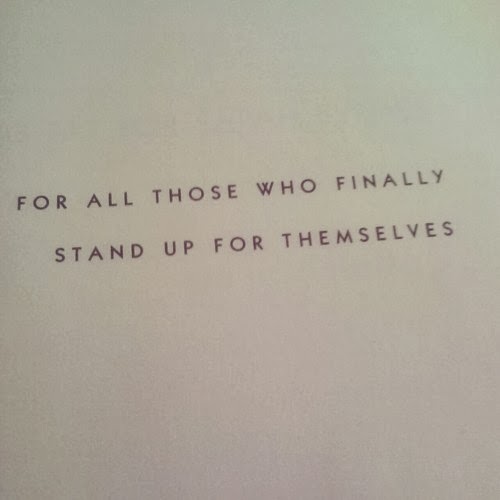
The book's intriguing dedication.


Saturday, January 25, 2014

Hick (2011)


Contrary to the brutally negative reception for this film, I found "Hick" to be a solid film with a powerful theme and an engrossing main character. I actually thought it was better than the director's earlier effort, "Lymelife" (2008.) Rory Culkin gave it his best shot, but the Suburban family dysfunction motif is so 'done,' and y'know, Emma Roberts plays the same damned character in every freaking movie she's in.

   The often-overlooked Culkin brother is in this too in a small part, but Chloe Grace Moretz runs the show as Luli, a sexually provocative yet heartbreakingly vulnerable 13-year-old and the product of drunk loser parents (Anson Mount and Juliette Lewis) living in small town, Nebraska. Disenchanted with her going-nowhere life, Luli hitches a ride from a limping young man (Eddie Redmayne,) a decision which turns out to be the most dire of her life.

   Chloe Grace Moretz is a good little actress, although she still has a lot of room to improve, and seeing her flounce around in her underwear and act sexually precocious might bother a lot of people. But it's important to remember that Moretz is not a little girl anymore, and is gradually working her way into more mature roles (maybe a little faster than we would like.)

   Luli is a dynamic character. Early on, as she points her revolver in the mirror and quotes lines from famous
Pubescent Moretz provokes controversy.
films, we see a girl who has been hurt to many times, and needs a lifeline of any kind to stay afloat. Later, when she asks her mother's boyfriend if she's pretty, our heart aches for her- we want to be there for this lonely, desperate girl, yet can only watch her fumble and fight with the challenges of an unusual adolescence through the screen.

   Unfortunately, the other characters are singularly nasty and unlikable, almost unbearably at times. Most of them seem to exist primarily to abuse, let down, and exploit Luli, to the exclusion of anything else. Redmayne gives a good performance as Eddie, the boy who picks Luli up, but by the end it is impossible to feel any sympathy for him.

   Just because we are traveling from one little hick town to another, does that mean the men can't show a little chivalry towards a struggling teenage girl? It is disturbing, but also ludicrous, how each odd character Luli meets seems to be indescribably broken and mean spirited. That said, I never got bored during this movie, and was fascinated by Moretz's little traveler.

   I've liked Moretz since "Kick-Ass," and she shows maturity and screen presence as the lead character. Watch this for her and Redmayne, if for no one else. While Redmayne is appropriately vile, the film finds an unlikely heroine in Luli, sometimes sour, sometimes sweet, but always compelling.
                                            Rating- 
                                                   6.5/10
When lines are crossed.


Sunday, December 29, 2013

The War Zone (1999)

 
Actor Tim Roth's dictatorial debut is also an exquisitely acted masterwork about the dark secrets surrounding a middle-class British family, with Lara Belmont stealing the show as the abused daughter. Teenager Tom (Freddie Cunliffe) is horrified but initially fails to intervene when he realizes his older sister (Belmont) is carrying on an incestuous relationship with their father (Ray Winstone.)

   Winstone, who is primarily known by the public for imposing-baddie-with-a-cockney-accent kind of roles, really sells it as a monster of a human being. You will hate this man so much you will want to vomit. Tilda Swinton plays Mum, who is pregnant at the start of the film, and later has a baby girl named Alice.

   The weird thing is, Tom doesn't immediately see his older sister as a victim, even as he looks on as she is raped by her father. In fact, Jess (the sister) doesn't always see herself as a victim either. I don't think she thinks she deserves to be saved. She occasionally fancies herself a Daddy's girl, and may very nearly likes the attention and the meager pleasures of the ever more frequent assaults.

   She teases Tom, coyly denies it. Tom seems to blame Jess for the impending disintegration of their family, rather than the piece of human excrement who sits at their table, eats their food, makes love to their mother like his interests aren't directed elsewhere. While 'Dad' is a monster, Tom isn't exactly sympathetic either, and Jess initially raises question of whether she likes Daddy's attentions, and, in fact, is complaint in the incest.

   This is not a movie for the weak of heart. I was disgusted, but in a good way if you know what I mean. This movie is a hundred times scarier than "The Shining" and a hundred times more grotesque than "The Human Centipede II (Full Sequence,)" if only because it is firmly rooted in reality. The only thing I can think to compare it to is "Tyrannosaur," another great movie who was also directed by a UK actor (Paddy Considine.)

   This movie is not about ghosts, devils, evil entities, or masked killers. It's about the evils people do, the atrocities that can take place in a more or less regular household. While the lack of sexual boundaries the family exhibits is off-putting, it doesn't seem to incorporate abuse at first. Oh, how wrong you are, filmgoer.

   I recommend this amazing movie to people with very strong stomachs. The acting is great all around and the script is nearly flawless. I'm still floored that Lara Belmont did no professional acting prior to this movie. Her acting will blow you away. One of the most underrated performances ever. I hope Tim Roth can find time to make another movie in addition to his acting career. Purely, and simply... great.
                                                                Rating-
                                                      9.0/10


Saturday, January 12, 2013

Sunday, November 11, 2012

Tyrannosaur

Emotionally devastating and rewarding, a study of desperate individuals with seemingly nothing to lose, "Tyrannosaur" is one to put on your watch list. Now. Featuring electrifying performances from Peter Mullan, Olivia Coleman, and the criminally underused Eddie Marsan, it is as riveting as it is disturbing and shocking.

   Joseph (Peter Mullan) is a man seething with rage and contempt. When we first see him, he is leaving a bar after a fight. Irritated suddenly by the whining of his dog, tied up outside, he gives it a fatal kick in the ribs.

   Joseph seems to have this effect on everyone who crosses his path, and he certainly seems incapable of any lasting change, but that doesn't stop kind Christian charity shop worker Hannah (Olivia Coleman) from trying to help, to Joseph's great puzzlement.

Something is Killing Tate

Although putting down a movie as weirdly good-intentioned as "Something is Killing Tate" incites guilt in me, the truth must be told, so here goes. This film, an unholy mix of earnesty, melodrama, and blaxploitation cheesiness, comes up with a hodge-podge of issues -- suicide, rape, child abuse, alcoholism, adultery, and childhood disabilities -- dials them up to the extreme, and expects to be taken seriously.

   Tate (Jocko Sims) is dying inside... an unfortunate victim of childhood abuse by his father (Kevin Nichols, a cartoon caricature of larger-than-life proportions.) After a failed attempt to take his life, he is looked after by his fiance and friends. Tate's feeling of impending doom stops him from hopping into bed with his best friend's girl (Luz Beato, who sleazes and pouts her way through the movie, never once convincing us that she has a brain.)

Friday, April 6, 2012

Red, White, & Blue


If you have seen this director's previous U.S.-available effort, The Living & the Dead, you'll know the drill- everything that can go wrong does, and his films navigate the uncomfortable grey areas of the human psyche. Being a fan of Simon Rumley's The Living & the Dead, I decided to check it out, despite similarly mixed reviews and a nagging feeling in the back of my gut.

    Boy, this film is brutal. If Rumley meant to outdo the violence and nihilistic tone of his previous movie, he succeeded. All the main characters make uniformly bad and immoral decisions, and all of them suffer for it. The movie starts out with a sleazy feel, with promiscuous Erica (Amanda Fuller) getting into bed with random strangers at a nightclub.

     Then she meets Nate (Noah Taylor,) who got a honorable discharge from Iraq. Although he tips her off almost immediately that he has a history of torturing and killing animals, Erica is drawn to him, mostly because he is the first man in a long time who doesn't seem to be after sex.

   The film then puts a third character into the mix, Franki (Marc Senter), who is taking care of his sick mother Ellie (Sally Jackson. whose kind and sympathetic character reminds the viewer of Kate Fahy's Nancy in The Living and the Dead.) Franki has a rock band going with his various buds and hates his father. The family is thrilled when Ellie goes into remission, but tragedy lurks just around the corner, and Erica's crime has unexpected repercussions.

   Gandhi's advice, "An eye for an eye leaves the whole world blind," seems to apply here. Like Todd Field's In the Bedroom, revenge only hurts those who practice it, and no one seems to get much gratification out of it (except for one, who is basically a sociopath.) But even the sociopath is capable of compassion,, which makes the dynamic between the characters all the more puzzling.

   . I love Rumley's style, with his moral ambiguity, interesting cinematography, and tense situations. But Red, White, & Blue has scenes and gaps in storytelling that make it seem less professional. The music during the torture scenes, for instance, is discordant and not in a good way, like taking bad inspiration from Psycho. Some scenes open awkwardly in the middle of the action, and end just as uncomfortably. An example is when Erica is almost raped by a co-worker.

   The beginning shot of the scene takes place in the middle of the attack, and Nate lingers for a moment before hitting the attacker with a hammer off-screen. The next scene shows Nate approaching and sitting next to a teary Erica. But happened to the would-be rapist? Was he killed and his body disposed of? Arrested? Taken to the hospital? He disappeared without a trace. There are several scenes like that, which leave the viewer rather confused.

     Some of the dialogue is rather stiff and drawn out, and several lines sound alien from the way  anyone I know speaks. The acting is good, however, with unknown actors (Amanda Fuller, Marc Senter) turning in capable performances. Noah Taylor, who you may know as the teenage version of the pianist David Helfgott in the biopic "Shine," does creepy and brutal nicely. And the last scene of violence goes above and beyond over the top, amounting to one of the most disgusting things I've seen in a long time.

     Should you see it? Despite panning reviews, it's not "only an exploitation film." Although it is a bit rough at times. it has a sense of style and has Rumley's essential humanity, light amongst the darkness. Go see it if you have a strong stomach, and be sure to watch The Living and the Dead, which has a classy Gothic atmosphere and more involving, likable characters.

Monday, March 26, 2012

El Bola


   Shortly into El Bola, the twelve-year-old protagonist overhears a woman at his family's shop tell his father that "if we were Pablo's age, we wouldn't have any problems." If only that were true. Not only is that false in general terms (cartoonist Bill Watterson once said that "People who get nostalgic about childhood were obviously never children,") but Pablo is living with a load that would be unbearable for anyone, in a household where breathing could get one beaten.

 El Bola is a full-blooded film about child abuse, yet lacking cheap shock value (Joan Crawford smudged with face cream, screaming "NO WIRE HANGERS!" while her little daughter cowers, comes to mind.) Instead of a larger than life -- not to mention over the top -- performance as the crazy parent that wins a Razzle, this movie concentrates on the children affected. Not only that, but it directs these performances well, which is hard to do.

     Sad-eyed Juan (José Ballesta), as Pablo, is the emotional center of the film. Pablo calls himself  "Pellet," named after a little ball he keeps for luck, which doesn't seem to do him much good.  He harbors an almost dog-like desire for a close friend, instead of the group of kids with whom he plays a dangerous game on the train tracks, further jeopardizing his safety, This security is found with Alfredo, the rough-around-the-edges son of a tattooist, who doesn't take to him at first, when he finds his pleas for friendship desperate-bordering-on-the-creepy. They bond quickly at an amusement park, taking us to the main conflict in the film, when Pablo's sadistic pop, Mariano, finds his son's aloneness threatened and tries to drive other people out of his life.

     Alfredo's family's a wonder to a kid who has never known a home life without violence and painful punishment. A liberal, playful bunch, they talk about just about anything and joke and laugh at the dinner table, a far cry from Pablo's family, with his mother yelling at his incontinent grandmother and his father constantly comparing Pablo to their other son who died in a car crash. But Alfredo's life is far from perfect. His father has a temper as well. His gay godfather is dying from AIDS, and he isn't allowed to see him due to the state he's in.

   The amazing thing about this film, which won the Spanish Academy Awards, and the child actors who have chosen to work in it, is the naturalness. The kids are not dumbed down or made into pretentious little douches who must read the dictionary every night before bed.  They're living, breathing, thinking humans. (I'll underline "thinking" for future filmmakers to pay close attention to). They talk about death, sickness, food and phallic tattoos (can you get one? I don't know, and I suspect they don't either.) The dialogue seemed rarely scripted and very natural.

   So what?  I won't give a four-star rating, because, well, the character development isn't quite strong enough, but it's certainly a impressive debut with kids who, now that they're grown, are on the way to becoming great actors. It's very much worth watching. The question is, are you up for it?

(Rated NR. Although it is rather perversely categorized as a "father-son children & family movie" on Netflix, it is definitely not for kids.)


Thursday, March 22, 2012

The Weight of Silence by Heather Gudenkauf


Seven-year-old Calli hasn't spoken since she was four years old, when a traumatic incident robbed her of her voice. She has been diagnosed with selective mutism. She communicates intuitively, without speech, with her best friend Petra, who often speaks for her. No one -- including her teachers, her devoted mom, Antonia, and Griffith, her angry alcoholic father, can entice her to speak. Only her beloved older brother, Ben, and a gifted school counselor seem to understand that her silence is not a choice, and that coaxing and bribery won't help. Fourteen-year-old Ben, who seems preternaturally mature and brave, protects his little sister -- hands down, he's my favorite character.

One morning, both Calli and Petra disappear. In alternating scenes, we watch Calli go through a grueling ordeal in the wide Iowa forest that has always been her refuge, as we watch the investigation unfold. Throughout the day, we also come to intimately know each of the characters. As the girls' parents struggle with their fear and guilt over their missing children, other memories unravel, some wonderful and some charged with regret and shame.

The Weight of Silence was a suspenseful story, full of complex characters. It moved fluidly among various points of view, adding richness and complexity without losing the silky flow of the story.
Folks, I couldn't put this one down. The suspense hooked me in, but what held me were characters I cared deeply about and themes that -- for me -- cut painfully close. It was a story about parental love, regrets in marriage and parenthood, and the agony of feeling we've failed those we love most. It was also about love, forgiveness and hope.

Another thing I enjoyed about the book was the carefully observed nature scenes. I could see, hear, and feel the life in the woods -- which seemed to have a faintly magical quality. The author illuminated those corners of childhood which include picnics in trees, marveling over a fawn wandering in the forest, and cicada shells preserved in treasure boxes.

My only quibble was that I was disappointed in the ending. The resolution seemed contrived and predictable to me. However, I recommend this book to fiction lovers, particularly those who, like me, are suckers for family dramas. I will warn you that a child is physically and sexually assaulted, though there is nothing explicit.

This novel has been on tour in the blog realm, so die-hard book blog readers have probably been seeing it pop up again and again. Here are some other reviews:
Also check out this interview with the author at Word Lily

Rating: 4


5- Cherished Favorite4 - Keep in My Library3 - Good Read2 - Meh1 - Definitely Not
For Me

Thursday, January 19, 2012

The Trouble With Half a Moon by Danette Vigilante


Since her brother died in a tragic accident, 13-year-old Dellie's world has constricted tightly around her. Her mother so desperately wants to keep her safe that she seldom lets her leave the apartment.  While wading through her own tremendous grief and guilt over her brother's death, Dellie has to navigate all the challenges of daily life: failing math tests, being noticed by her crush, and the drama of 7th grade girls. Not to mention living in a low income apartment building, where her sleep is shattered one night by gunshots.

Several new people enter her life, challenging Dellie and her mother to step outside their fears. These include a somewhat eccentric Jamaican neighbor and a needy boy who reminds her painfully of her brother. After being frozen in time since the tragedy, her family slowly begins to move again, though their lives will never be the same.

This is a relatively easy book that will appeal to middle grade readers as well as teens. But I'll warn you: it's a tear-jerker. I rarely cry during books or movies, but I was sniffling by the end of this story. I appreciate the fact that this author respects her young audience enough not to avoid difficult themes, including grief, guilt, child abuse and neglect, and poverty.

I liked the fact that this novel touched on people's misconceptions about poverty. I am amazed at the way people in our culture blame others for their misfortunes, especially poverty. I don't know whether this is the dark side of our capitalist philosophy or simply a facet of human nature. We convince ourselves that people cause their own problems, so we feel "safe" -- if we work hard and do the right thing, it could surely never happen to us. Danette Vigilante touches on this delusion:
The people who live here are poor, but for different reasons. Not everyone knows that. They think we're all the same. But that's not true. Some people spend their money on drugs and beer. Others, like my parents, are just working poor. My father drives a forklift all day and my mother works in a clothing factory packing up store orders. They go to work every day but don't get paid much. My father says he'll sell his soul if that's what it'll take for me to go to college.
Kayla and her mother lived in a big building with a doorman before her mother lost her job on Wall Street ...
I also liked the fact that this book was about a Puerto Rican American family, and it touched on food and other cultural traditions, yet ethnicity and race was not the focus of the story. Though I love learning about other cultures, and am intrigued by people's feelings and attitudes about their ethnicity, this is only a part of our identity and life experience. I like to see novels feature a rich variety of races and cultures without stories always being about that.

This is a memorable novel, with a young protagonist I quickly grew to love. One thing disappointed me; I wished the secondary characters were more fully developed. I got a one-dimensional picture of Dellie's parents, friends, and neighbors. Perhaps the author wanted to keep this novel short, making it accessible for younger readers.

The Trouble With Half a Moon will be well loved, especially by middle school aged readers (around ages 11-14). This is Danette Vigilante's debut novel; I look forward to seeing what she creates in the future.

Many thanks to Stacey Barney at Putnam for sending me an ARC of this book. You can visit the author at her blog -- how could you not love somebody who fights Klingons with her hubby on Halloween? :-)


Rating: 4


5- Cherished Favorite4 - Keep in My Library3 - Good Read2 - Meh1 - Definitely Not
For Me

Saturday, January 14, 2012

Purple Hibiscus by Chimamanda Ngozi Adichie


Purple Hibiscus takes place in Nigeria as the nation teeters on the brink of a political coup. This instability has been provoked by the government's harsh repression of free speech; journalists are risking their lives to stand up for freedom. Wrapped within this larger story is the tale narrated by 15-year-old Kambili, who watches her family's stability unravel after her brother Jaja makes his own bid for freedom.

It happens on Palm Sunday when Jaja doesn't go to communion. The children have spent their lives in a elegant, carefully ordered home where they've lived in terror of their maniacally religious, controlling father. Kambili and and Jaja just returned from a 10-day visit to their aunt and cousins in an academic community. Aunty Ifeoma's house lacked the material comfort to which they were accustomed, but for the first time the kids experienced a kind of faith and way of life that is filled with joy and laughter. They all participate in household chores, actively contributing to the family's survival and well-being. Physical punishment is relatively mild. And the children are actively encouraged to disagree and debate the issues of the day. Having experienced a taste of freedom, Kambili and Jaja are changed.
Jaja's act of defiance, refusing to take communion, triggers a storm in their family.
Everything came tumbling down after Palm Sunday. Howling winds came with an angry rain, uprooting frangipani trees in the front yard. They lay on the lawn, their pink and white flowers grazing the grass, their roots waving lumpy soil in the air. The satellite dish on top of the garage came crashing down, and lounged on the driveway like a visiting alien spaceship. The door of my wardrobe dislodged completely. Sisi broke a full set of Mama's china. Even the silence that descended on the house was sudden, as though the old silence had broken and left us with sharp pieces. p. 257
Throughout the novel, as in the above quote, the story of Kambili's family and her difficult journey through adolescence are seamlessly connected to descriptions of the natural world around them. Their experiences are reflected in nature, in a way that is sometimes tumultuous and sometimes wondrous. For example, after spending time at Aunty Ifeoma's house and becoming aware of herself as a person who has thoughts and feelings separate from her father's, Kambili has a spiritual awakening. It begins this way:
We stood underneath a huge flame-of-the-forest tree. It was in bloom, its flowers fanning out on wide branches and the ground underneath covered with petals the color of fire. When the young girl was led out, the flame-of-forest swayed and flowers rained down. p. 274
This novel is gorgeous. I loved the sensual beauty of the imagery, the vibrant color, and the vivid descriptions of the flora, fauna, and climate of Nigeria.

The author's exploration of Kambili's psyche is so real I felt I was a part of her. I loved watching Kambili become aware of her own body and begin to experience her own emotions and really feel the world around her.

The other characters are also beautifully drawn and complex. Kambili's father, Eugene, could easily have been a caricature and a person who seems unworthy of the reader's compassion. He commits horrible acts against his family, and he lives in luxury while surrounded by impoverished families; it's a somewhat feudal sort of community. Yet he is fully human. He stands up for human rights and pays tuition for many needy children. And at moments, he shows deep love and tenderness for his family. His charity work and loving moments with his family are inextricably entangled with his need to control others. However, I couldn't entirely loathe him.

Kambili's passive and emotionally damaged mother is also a complicated character; I couldn't predict exactly what she would do. I was equally drawn to her brother Jaja, their fiercely intelligent and kind but flawed Aunty Ifeoma, their grandfather, who practices traditional "pagan" beliefs, and Aunty Ifeoma's brilliant, feisty and outspoken children.

What shines most of all, I think, are the myriad themes woven into Purple Hibuscus. It explores control versus freedom, which we see played out within an individual, in a family, in a community and nation, and throughout the world. It probes the conflict between traditional tribal beliefs and "white man's religion" in post-colonial Africa. It explores the cruel marriage between religion and repression, and it also gives us glimpses of what genuine faith, rooted in personal freedom, can be. At the same time, it looks at the role nature plays in people's everyday lives and a young girl's coming of age.

While it is heart-wrenching, this is ultimately a hopeful story illuminated by love, personal awakening, and the persistence of human desire for freedom. I highly recommend it, especially for readers who enjoy contemporary literary fiction and are interested in African cultures.

Read More Reviews: S. Krishna's Books; One More Chapter; A Striped Armchair; Book Addiction; A Book Blog. Period.; Things Mean a Lot


Rating: 5


5- Cherished Favorite4 - Keep in My Library3 - Good Read2 - Meh1 - Definitely Not
For Me