Showing posts with label Dysfunctional Family. Show all posts

Friday, February 7, 2014

We Are What We Are (2010)

   
Family values takes a whole new meaning in Jorge Michel Grau's eerie cannibalism thriller "We Are What We Are," and the menace of the movie is both strange and psychologically intriguing. Sexual politics and bodily mutilation take the front wheel in this nightmarish horror film, and no one is safe. When the patriarch of a strange, impoverished family in Mexico dies dramatically, the bereaved are compelled to carry on as they always have. But this time 'carrying on' doesn't mean washing clothes, commuting to work, and buying groceries- Father's clan is a family of cannibalistic killers, and someone must take the job of hunting their human prey.

   While Mother (Carmen Beato) locks herself in the room and falls apart, her two sons- impulsive, violent Julien (Alan Chávez) and the more methodical, repentant Alfredo (Francisco Barreiro) squabble and their beautiful sister Sabina (Paulina Gaitan) plays them against each other. Alfredo laments that his mother never liked him and tries to prove himself to the others, while Julien, a loose cannon, postures and puts his family in grave danger with his recklessness.
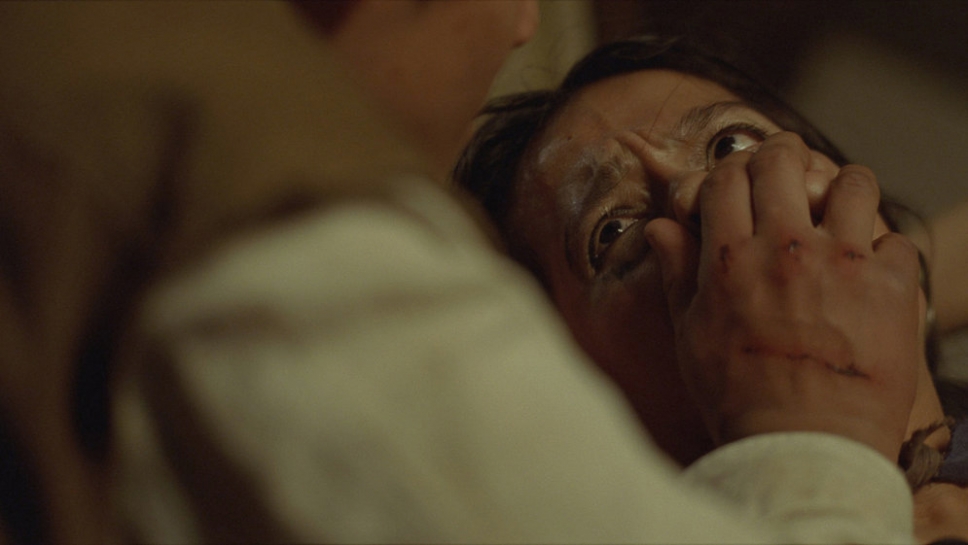

   Meanwhile, two somewhat corrupt cops track the family, after a gory incident involving a prostitute threatens to put their strange lifestyle on display. The film builds tension with spooky cinematography and a nerve-wracking violin score akin to "The Shining." The acting is superior from the entire cast, especially Paulina Gaitin and Francisco Barreiro (who is also a cutie- I look forward to seeing him in "Here Comes The Devil."
   The first scene is a haunting study of disenfranchisement- as Father  (Humberto Yáñez) wanders the streets and stops before a display of mannequins, he falls to the ground and begins to spit up blood. After dying in the street, he is nonchalantly cleaned up along with his blood, and steadfastly ignored by passersby, as the violins on the soundtrack shriek. This sets the tone for a grim and bloody picture that is sadly underrated by the public.

   There is recurring theme of women in low-class situations asserting power as best they can- Sabina manipulates her two brothers with her gentle words and her gorgeous body, while mother attempts to maintain control of her sons. And the prostitutes... well, you'll have to see how that turns out. More disturbing than the graphic violence is the dehumanizing way the family talks about their victims (they're 'whores' and 'faggots,' never people.) More disturbing still is the way you start to root for the family, ever so slightly, before you can stop yourself. They suck you into their world, and things you know are wrong seem intriguing.


   I wish the characters of the police had been developed more. I definitely think the climactic scene would have been more compelling if the main cop hadn't just tried to pick up a prostitute who was like twelve, destroying any meager sympathy we may have had for him. After that, I don't care whether he lives or he dies... I'm actually rooting for the man-eating psychos at this point.

   The 5.7 rating of this movie on Imdb makes me sad. I only checked the clock once during "We Are What We Are," and that was when my sister asked from the other room how much was left. This movie was engrossing and not boring at all, and I thoroughly enjoyed watching it. I love how foreign horror films don't feel the need to reveal everything in the first five minutes. It is compared to "Let the Right One In" on the back of the box. Well, I wouldn't call it better ("Let the Right One In" is my favorite movie,) but it was well-made and highly enjoyable. A creepy slow-burner of a horror film.
                                       Rating- 
                                             8.0/10


Saturday, August 17, 2013

The Baby (1973)

"The Baby" is a very weird 'cult classic' (their words, not mine) about a lady social worker who interferes with the matriarch's hold on a supremely dysfunctional family. The object of social worker Ann Gentry (Anjanette Comer)'s obsessions is 'Baby,' a full-grown man (or 'grown-ass man' to quote Will Smith in the so-so "Men in Black" sequel) who is kept in a crib and clad in diapers.

   Ann seems to believe that the seemingly mentally handicapped fellow is simply the otherwise functional victim of too much negative reinforcement during his development (bad baby! Stop standing up!") To his sister Alba (Susanne Zenor,) Baby is a scapegoat, to his other sister, Germaine (Marianna Hill,) he is a plaything. But what exactly does the seemingly wholesome Ann want with Baby? What secret lies under the surface of her white bread exterior?


Saturday, March 31, 2012

The Butcher Boy by Patrick McCabe


Francie Brady, the young narrator of this dark Irish novel, opens the book by saying, "When I was a young lad twenty or thirty or forty years ago I lived in a small town where they were after me on account of what I done on Mrs. Nugent." It's safe to say the reader has fair warning that the book will not end well.

Set in Ireland in the early 1960's, this novel takes us into the home of the Bradys, a poor Catholic family. Francie's father is an alcoholic, and his mother is mentally ill -- my guess is that she has bipolar disorder. The reader lives in Francie's mind, carried along by a stream of consciousness that reminds me a bit of James Joyce's A Portrait of the Artist as a Young Man. The flow of his thoughts and experiences is beautiful, brutal and often confusing.

As Francie's family unravels, he becomes increasingly obsessed with the Nugents, a relatively affluent Protestant family. Their cherished only son, Philip Nugent, is one of his classmates; he has an impressive comic book collection and takes piano lessons. When Francie enters Philip's room, it is like stepping into a different world. Mrs. Nugent looks down on the Bradys and calls Francie a "pig." This only stokes his obsession. And gradually, Mrs. Nugent becomes Francie's scapegoat for all the problems and tragedies in his life.

We follow Francie's descent into madness, which continues through the death of his parents, his taking work as the butcher's boy, the only job he's considered suitable for, and the loss of his best friend. It also continues through his stint at a Catholic home for troubled boys, where he yearns to get his "Francie Brady is Not a Bad Bastard Anymore Diploma," and his encounters with a pedophile priest.

Throughout all this, the narrative veers between the real and the surreal; realities and delusions mingle fluidly. As he plunges into sociopathy, Francie remains heart-breakingly human and funny. And while the story is often disorienting and bleak, at times it's incredibly beautiful.

While this novel was difficult to read, it is one that will stick with me for years to come.

You might also like this review at The Guardian.

Rating: 4


5- Cherished Favorite4 - Keep in My Library3 - Good Read2 - Meh1 - Definitely Not
For Me

Saturday, January 14, 2012

Purple Hibiscus by Chimamanda Ngozi Adichie


Purple Hibiscus takes place in Nigeria as the nation teeters on the brink of a political coup. This instability has been provoked by the government's harsh repression of free speech; journalists are risking their lives to stand up for freedom. Wrapped within this larger story is the tale narrated by 15-year-old Kambili, who watches her family's stability unravel after her brother Jaja makes his own bid for freedom.

It happens on Palm Sunday when Jaja doesn't go to communion. The children have spent their lives in a elegant, carefully ordered home where they've lived in terror of their maniacally religious, controlling father. Kambili and and Jaja just returned from a 10-day visit to their aunt and cousins in an academic community. Aunty Ifeoma's house lacked the material comfort to which they were accustomed, but for the first time the kids experienced a kind of faith and way of life that is filled with joy and laughter. They all participate in household chores, actively contributing to the family's survival and well-being. Physical punishment is relatively mild. And the children are actively encouraged to disagree and debate the issues of the day. Having experienced a taste of freedom, Kambili and Jaja are changed.
Jaja's act of defiance, refusing to take communion, triggers a storm in their family.
Everything came tumbling down after Palm Sunday. Howling winds came with an angry rain, uprooting frangipani trees in the front yard. They lay on the lawn, their pink and white flowers grazing the grass, their roots waving lumpy soil in the air. The satellite dish on top of the garage came crashing down, and lounged on the driveway like a visiting alien spaceship. The door of my wardrobe dislodged completely. Sisi broke a full set of Mama's china. Even the silence that descended on the house was sudden, as though the old silence had broken and left us with sharp pieces. p. 257
Throughout the novel, as in the above quote, the story of Kambili's family and her difficult journey through adolescence are seamlessly connected to descriptions of the natural world around them. Their experiences are reflected in nature, in a way that is sometimes tumultuous and sometimes wondrous. For example, after spending time at Aunty Ifeoma's house and becoming aware of herself as a person who has thoughts and feelings separate from her father's, Kambili has a spiritual awakening. It begins this way:
We stood underneath a huge flame-of-the-forest tree. It was in bloom, its flowers fanning out on wide branches and the ground underneath covered with petals the color of fire. When the young girl was led out, the flame-of-forest swayed and flowers rained down. p. 274
This novel is gorgeous. I loved the sensual beauty of the imagery, the vibrant color, and the vivid descriptions of the flora, fauna, and climate of Nigeria.

The author's exploration of Kambili's psyche is so real I felt I was a part of her. I loved watching Kambili become aware of her own body and begin to experience her own emotions and really feel the world around her.

The other characters are also beautifully drawn and complex. Kambili's father, Eugene, could easily have been a caricature and a person who seems unworthy of the reader's compassion. He commits horrible acts against his family, and he lives in luxury while surrounded by impoverished families; it's a somewhat feudal sort of community. Yet he is fully human. He stands up for human rights and pays tuition for many needy children. And at moments, he shows deep love and tenderness for his family. His charity work and loving moments with his family are inextricably entangled with his need to control others. However, I couldn't entirely loathe him.

Kambili's passive and emotionally damaged mother is also a complicated character; I couldn't predict exactly what she would do. I was equally drawn to her brother Jaja, their fiercely intelligent and kind but flawed Aunty Ifeoma, their grandfather, who practices traditional "pagan" beliefs, and Aunty Ifeoma's brilliant, feisty and outspoken children.

What shines most of all, I think, are the myriad themes woven into Purple Hibuscus. It explores control versus freedom, which we see played out within an individual, in a family, in a community and nation, and throughout the world. It probes the conflict between traditional tribal beliefs and "white man's religion" in post-colonial Africa. It explores the cruel marriage between religion and repression, and it also gives us glimpses of what genuine faith, rooted in personal freedom, can be. At the same time, it looks at the role nature plays in people's everyday lives and a young girl's coming of age.

While it is heart-wrenching, this is ultimately a hopeful story illuminated by love, personal awakening, and the persistence of human desire for freedom. I highly recommend it, especially for readers who enjoy contemporary literary fiction and are interested in African cultures.

Read More Reviews: S. Krishna's Books; One More Chapter; A Striped Armchair; Book Addiction; A Book Blog. Period.; Things Mean a Lot


Rating: 5


5- Cherished Favorite4 - Keep in My Library3 - Good Read2 - Meh1 - Definitely Not
For Me